
Bournemouth, UK – In the corporate IT environment and the open-source software sector, connecting Enterprise Resource Planning (ERP) systems with telecommunications infrastructure is a well-known operational requirement. However, previous market implementations have largely relied on legacy software versions or required the deployment of custom, hard-to-maintain middleware scripts.
Today, SolutionsInc is proud to announce the official release of a fully native ERPNext 16 and FreePBX 17 integration. The seamless combination of these two specific, latest system releases remains a rarity in the B2B deployment market, offering organisations unparalleled opportunities to optimise their communication workflows.
This cutting-edge solution is now available as part of the SolutionsERP platform. The integration architecture bridges the powerful Asterisk telecommunications engine version 22.7.0 (managed via the FreePBX 17.0.28 interface) with the robust Frappe framework, which powers ERPNext 16.10.1. This technical overview details the capabilities of this environment, particularly for enterprises where a reliable CRM and VoIP integration or the connection of manufacturing (MRP) modules with a PBX forms a critical component of their digital transformation strategy.
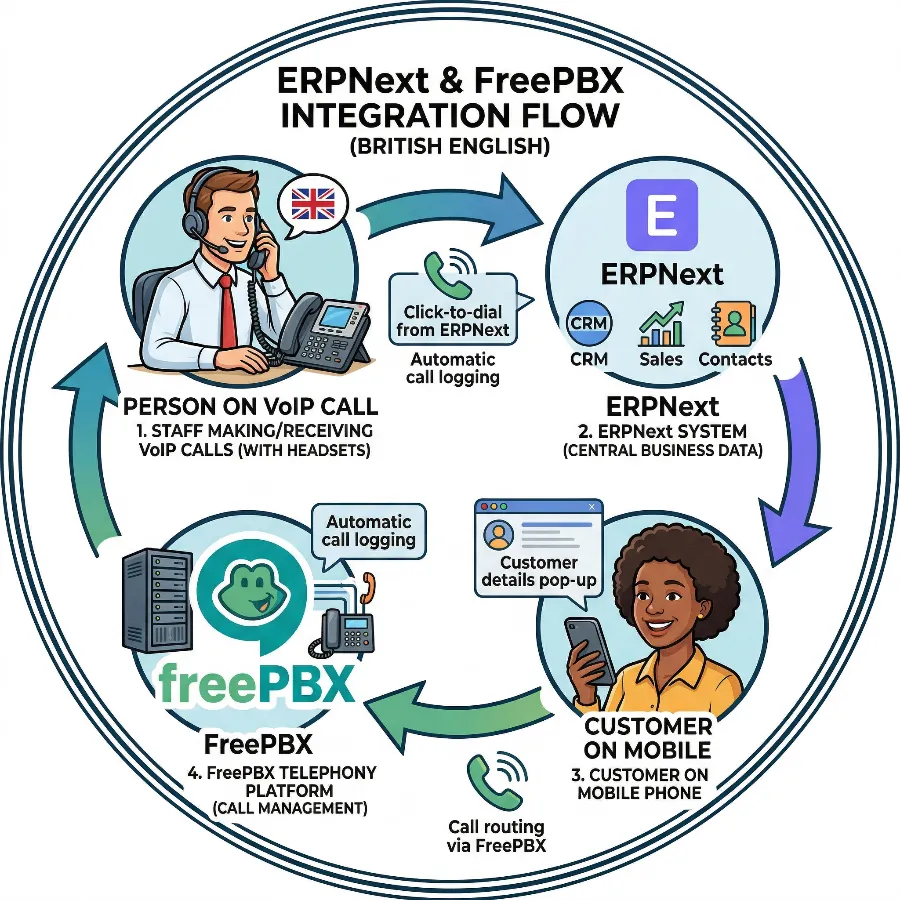
Why Modern ERP and PBX Integration is the New Market Standard
From the perspective of Chief Operating Officers (COOs), IT Support Directors, and Logistics Managers, isolated IT systems generate measurable financial and operational losses. Enterprises seeking workflow optimisation frequently analyse concepts such as ERP and PBX integration, primarily aiming to reduce the Average Handling Time (AHT) of client queries and improve information flow across the supply chain.
In production environments utilising Manufacturing Resource Planning (MRP) software, rapid communication with raw material suppliers is critical. When a delivery delay occurs, the procurement officer requires immediate access to the order history and the supplier’s contact details. A professional CRM and VoIP integration resolves this bottleneck by merging relational data with real-time communication channels. SolutionsInc, in strategic partnership with network and telecommunications experts from Phones Rescue, has engineered an architectural model that rigorously meets these demands.
Furthermore, for network engineers responsible for maintaining communications infrastructure, the technological foundation of the PBX itself is paramount. The direct ERPNext and Asterisk integration in its 22.7.0 release ensures support for modern audio codecs, high throughput for SIP protocols, and advanced routing capabilities, making this a highly stable, Enterprise-grade solution.
Architecture and Functionalities: The SolutionsERP and Phones Rescue Environment
Analysing the deployment environment requires an examination of the data flow between the end-user, the database, and the SIP server. Below, we outline the core functionalities offered by the optimised ERPNext 16 and FreePBX 17 integration, alongside a technical summary of their operation.
Middleware Layer and Transmission Security
A pivotal architectural aspect of this deployment is how these independent environments are bridged. To connect the entire ecosystem, our engineers opted to utilise the n8n platform as a flexible middleware layer. This forward-thinking architectural approach allows for the seamless addition of future functionalities, automations, and third-party systems without necessitating hard modifications to the core source code of the connected applications.
Adhering to stringent corporate security standards, every vector of information exchange has been fortified. All communication between the core systems (ERPNext, FreePBX, and the n8n instance) is conducted via secure connections authenticated by SSH keys and fully encrypted APIs. This guarantees the absolute confidentiality of transmitted client data and system logs, as well as the overarching integrity of the infrastructure.
Initiating Calls from the UI (Click-to-Call)
The necessity of manually dialling phone numbers on physical desktop handsets is an error-prone process (human error) that unnecessarily extends the working time of consultants. The SolutionsERP platform eradicates this step by natively embedding Click-to-Call functionality within the browser interface.
Leveraging RESTful APIs and asynchronous JavaScript requests, users can initiate a call from any database record (DocType). Whether viewing a client profile (Contact, Lead) or a supplier card for the production department (Supplier), the employee simply utilises the integrated “Call via Phones Rescue” action button.
Upon clicking, the ERPNext instance transmits an encrypted request to the FreePBX server. The PBX establishes a communication channel with the employee’s endpoint device (a SIP handset or softphone application), and upon answering, initiates the outbound call to the external client number. This structural CRM and VoIP integration standardises outbound processes, substantially increasing the daily call throughput of sales departments.
Real-Time Caller Identification (Inbound Popups for Asterisk)
The inbound call handling process requires providing the employee with immediate business context. When relying on standard, isolated telephony devices, identifying a client necessitates manually querying the database, which negatively impacts Customer Experience (CX).
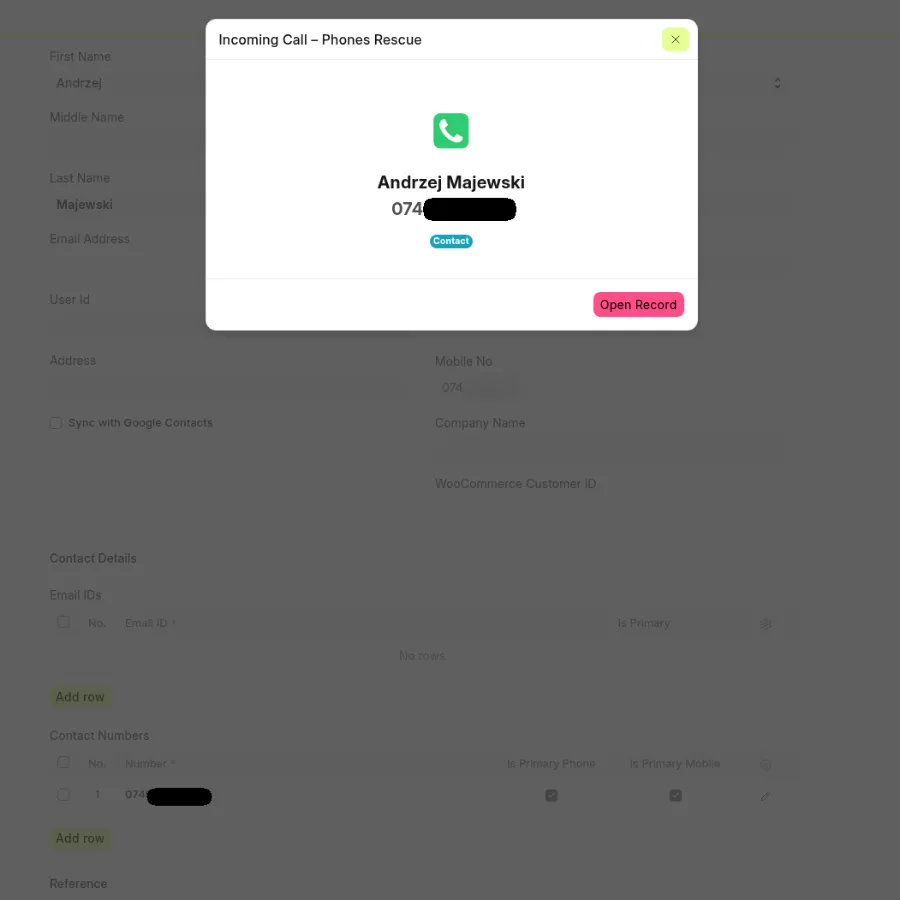
In the model delivered by SolutionsInc, when the FreePBX server (maintained by Phones Rescue) receives an incoming call, the Asterisk engine analyses the Caller ID. Subsequently, via WebHooks, it communicates with the MariaDB database connected to the ERPNext 16 system. If the number exists within the system, the user’s web interface instantly generates a Popup notification using WebSockets technology.
This window displays fundamental identification data and—crucially for usability—a direct hyperlink to the client’s record within the CRM/ERP system. From the very first second of the call, the receiving employee has full visibility into open sales opportunities, technical support ticket statuses, or invoice histories. Such an ERP and PBX integration constitutes the foundation of a modern Contact Centre workstation.
Advanced Traffic Analytics in the “Call Log” DocType
Effective management of customer service departments requires business decisions grounded in hard data. Technically, the Asterisk system generates detailed Call Detail Records (CDR). A complete ERPNext and Asterisk integration automates the parsing and transmission of these logs directly into the ERP database.
Within the SolutionsERP environment, a structured DocType named “Call Log” has been established. All communication metadata is logged here: initiation and termination timestamps, call duration in seconds, traffic direction, and endpoint identifiers. Centralising this data enables analysts to generate comprehensive reports entirely within the ERP system, bypassing the need to export raw logs (.csv) directly from the Linux shell on the PBX server.
Structural Call Recording Management
Archiving audio signals from conducted conversations is an industry standard (often mandated by legal regulations, such as in the financial sector). However, the persistent integration challenge has been correlating the audio file with the correct client record. The meticulously engineered ERPNext 16 and FreePBX 17 integration systematically resolves this architectural hurdle.
Centralised Audio Event Registry
SolutionsERP platform users have direct access to archived recordings via their web browser. Upon call termination, the audio file is processed and indexed within a dedicated “Call Recording” registry. The saved record encompasses vital relational parameters: the assigned internal extension, the linked client record, the call type, and its final status.
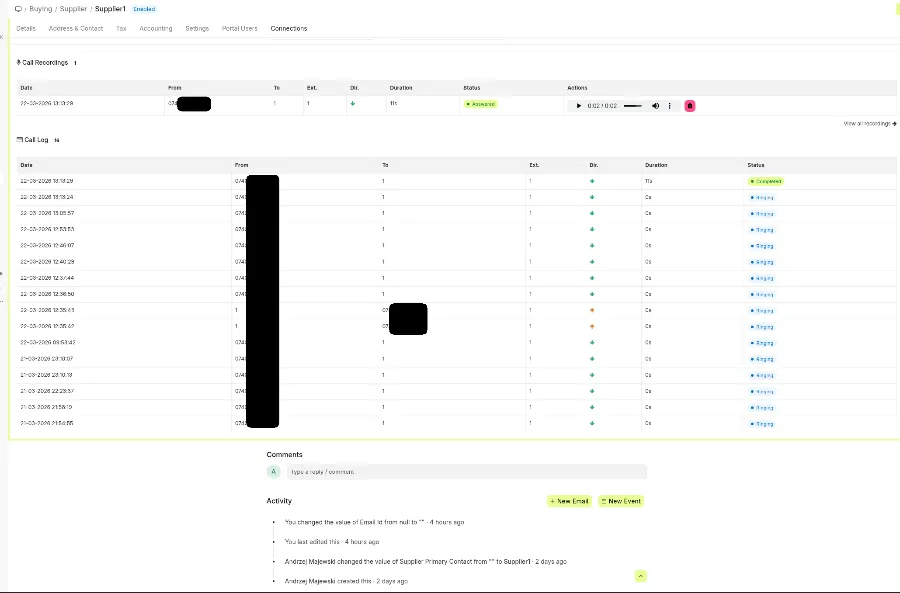
Logging statuses such as Answered or Missed Call is of critical managerial importance. A professional CRM and VoIP integration facilitates real-time monitoring of the abandoned call rate, which is one of the most vital Key Performance Indicators (KPIs) determining the continuity of business processes and after-sales support.
Contextual Recording Linking with Client Records
The Frappe framework’s data model allows for dynamic document linking. SolutionsInc has leveraged this architecture to embed recordings directly onto the Timeline of individual records. When accessing a prospective client’s profile (Lead) or a cooperating vendor’s file (Supplier), the employee gains immediate access to a chronologically listed history of recordings. This enables efficient review of previous agreements without leaving the task context.
Audit Tools for Quality Assurance Departments
Quality Assurance departments analyse hundreds of hours of recordings monthly, requiring robust playback software. The integrated player deployed within SolutionsERP features a native playback speed adjustment function.
The ability to alter the playback tempo (our player enables speed adjustments across a range of 0.25, 0.5, 0.75, 1.25, 1.5, 1.75, and 2x) significantly enhances the productivity of QA analysts. An effective ERP and PBX integration must deliver not merely the raw data, but also the appropriate interfaces for its efficient processing. For scenarios requiring long-term, offline archiving, files can be securely exported from the system.
Permissions Model and Data Security (RBAC)
Processing voice data and call logs is subject to rigorous legal frameworks, including the requirements imposed by the GDPR. The security architecture must guarantee access strictly in accordance with the Principle of Least Privilege.
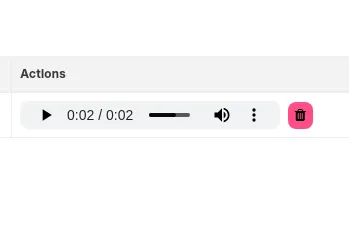
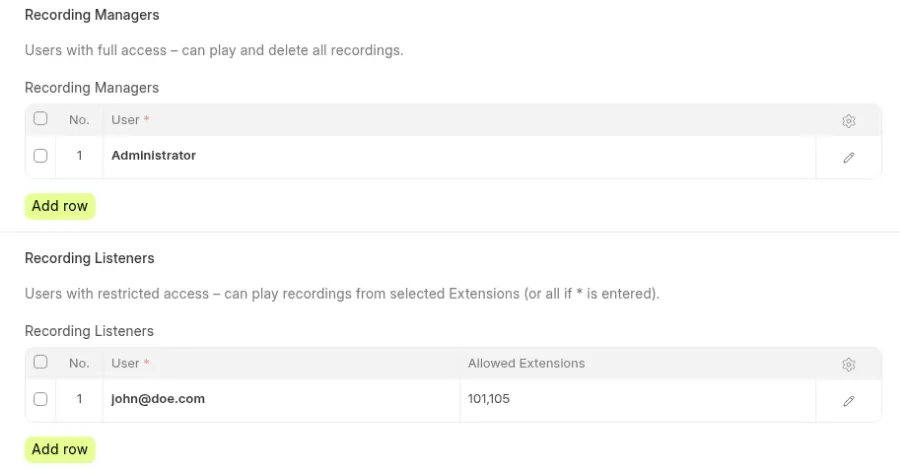
The ERPNext environment relies on a comprehensive Role-Based Access Control (RBAC) model. The standard deployment configuration of SolutionsERP restricts the visibility of logs and recordings exclusively to the user who was a party to the specific call (identified by their Extension number). A standard user account is entirely stripped of any privileges to modify or delete these records.
Broader access management is handled via the administrative “Phones Rescue Permissions” DocType. At this level, a system administrator can grant defined recording access across entire organisational structures (e.g., granting a manager access to the logs of their entire support department). In alignment with Enterprise standards, destructive operations (permanent deletion of files from the database and physical storage media) are reserved exclusively for the highly privileged “Recording Managers” system role.
Operational and Business Impact
The implementation of the SolutionsERP environment and advanced CRM and VoIP integration translates into concrete, measurable operational results for the enterprise:
- Working Time Optimisation (AHT): The Click-to-Call functionality eliminates manual number dialling. As demonstrated by tests conducted by Phones Rescue, the average time required to enter a number on a VoIP phone keypad—including the time needed to glance at the screen and visually verify accuracy—is a staggering 9.27 seconds per call, and even then, the process frequently results in dialling errors. Automating this stage quantifiably increases the efficiency of Contact Centre teams.
- Streamlined Data Retrieval and Elimination of Critical Errors: Real-time inbound identification (Inbound Popups for Asterisk) reduces the time required to locate relevant data by dozens of seconds per call. Crucially, market experience shows that during manual searches, consultants frequently open the records of incorrect clients (due to similar surnames or mishearing details over the phone). Such errors not only appear highly unprofessional to the caller but can also expose the company to severe legal consequences related to data protection breaches (GDPR). The SolutionsInc integration entirely eradicates this issue, as the link generated within the Popup directs the user straight to the correct record, flawlessly identified via the unique phone number.
- KPI Monitoring and Accountability: Centralising call logs (Call Log) with appropriately tagged missed opportunity statuses (Missed Calls) enables accurate assessment of telephone line loads and workforce optimisation.
- Supply Chain Security (MRP): Immediate access to the full history of audio agreements (Call Recording) directly within supplier cards facilitates the swift resolution of any discrepancies in delivery terms or production orders.
- Maintaining an Audit Trail: The immutable and restrictively permissioned log archive serves as reliable evidence in commercial disputes and external audits.
Implementation Procedure and Technological Prerequisites
Deploying this business-class environment requires meeting specific licensing and infrastructure prerequisites. The stability of the solution is contingent upon strict compatibility between the software components utilised.
For an enterprise to implement the automation suites detailed above, an active subscription to the SolutionsERP software, provided by SolutionsInc, is mandatory. An equally critical factor guaranteeing service quality is the telecommunications layer itself. The VoIP system, forming the backbone of voice communication, must be implemented from the ground up and configured for maximum security by our authorised deployment partner, Phones Rescue.
The combination of an authorised ERP system (SolutionsERP, based on ERPNext 16) with an optimised, highly secure telecommunications PBX (based on FreePBX 17 and the Asterisk 22.7.0 engine) represents a collaborative model that guarantees the ERPNext 16 and FreePBX 17 integration will operate at peak performance, assuring organisations of technical stability and a visible improvement in key operational metrics.
Contact Us
Companies and organisations interested in deploying this transformative solution within their IT environment are invited to contact the SolutionsInc Sales Department directly. Technological consultations, pricing, and a dedicated contact form are available at: https://solutionsinc.co.uk/contact/.
Leave a Reply