
The modern business environment in the United Kingdom is evolving towards unprecedented technological complexity and stringent legal requirements. For many companies, effectively optimised document management in the UK is no longer just a matter of office tidiness; it has become a critical vector for operational and financial security. Pressure from tax authorities, such as HM Revenue and Customs (HMRC), is constantly increasing.
The rapidly approaching deadline for the full digitalisation of tax processes, combined with severe penalties for breaching the UK General Data Protection Regulation (UK GDPR), is keeping Chief Financial Officers awake at night. In response to these challenges, advanced enterprise resource planning systems are emerging on the market. In this article, we will take a closer look at how the innovative SolutionsERP system, based on the powerful ERPNext 16 engine, is revolutionising the digital workspace of British enterprises.
Why is document management in the UK such a massive challenge today?
Enterprises operating in the British market are grappling with multidimensional pressure. On the one hand, we have the post-Brexit environment, which forces the strict enforcement of personal data protection regulations. On the other, a rising tide of sophisticated financial fraud, such as Business Email Compromise (BEC) attacks and invoice fabrication, directly threatens the financial liquidity of companies.
Distributed file archives, siloed IT systems, and the exchange of documents via unencrypted email are a direct route to disaster. Traditional document management in the UK is becoming inefficient. Companies waste hundreds of hours manually searching for contracts, verifying engineering project revisions, or cross-checking invoices against purchase orders. The answer to these pain points is the deep integration and consolidation of processes within a single, integrated operational environment.
To illustrate the scale of the problem and the effectiveness of new technologies, let us use the example of a mid-sized advanced engineering firm based in Bournemouth, Dorset. An analysis of this hypothetical, yet highly representative business environment, perfectly demonstrates how the SolutionsERP system transforms passive file repositories into active, automated financial control centres.
Frappe 16 Architecture: The Heart of SolutionsERP
To fully understand how modern software optimises operations, we must look under the bonnet. From a technological standpoint, the foundation for SolutionsERP is the latest iteration of the Frappe framework, version 16. It brings the most profound restructuring of the architecture since the software’s inception.
Frappe Caffeine: A Breakthrough in Database Performance
The most critical innovation for companies processing gigantic volumes of data is the new architectural layer called Frappe Caffeine. It optimises communication between the application and the database, resulting in an almost twofold increase in the performance of the entire system. For the aforementioned engineering firm in Bournemouth, which generates thousands of requests for quotation, technical drawings, and invoices, this means an immediate reduction in cloud server load by approximately 40%. Financial analysts no longer have to wait for the Consolidated Trial Balance to be generated – views load in fractions of a second. Such modern document management in the UK translates to colossal time savings.
New UI and Chrome Engine for Perfect PDFs
The user interface has also been redesigned. The implementation of the modern Tailwind CSS framework has significantly accelerated page rendering on the browser side. Features such as Scrollable Child Tables and Sticky Columns have been introduced, making it easier to work with massive datasets without needing to export them to Excel.
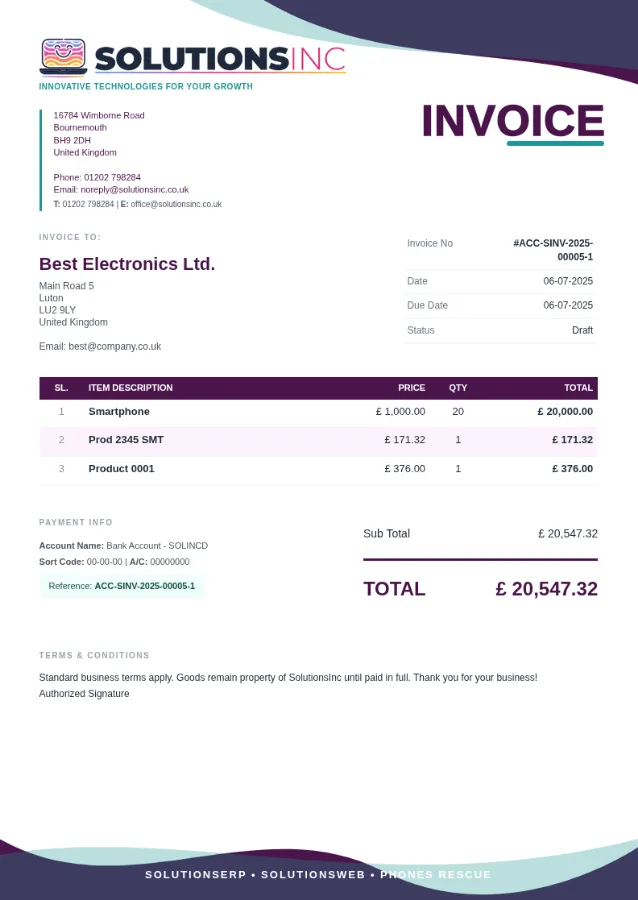
From the perspective of outbound document flow, a true revolution is the new PDF generator based directly on the Chrome browser engine. In older ERP systems, PDF libraries often “broke” complex tables or custom fonts. Using the Chrome engine in the background completely eliminates these errors. Every official quote, technical specification, or VAT invoice generated by the SolutionsERP system looks perfect and professional, which enhances the company’s credibility in the eyes of government and commercial partners.
Total Centralisation: Frappe Drive as the Answer to Chaos
A distributed work environment is the number one enemy of operational security. Employees storing files on local hard drives or unauthorised, free cloud services create security vulnerabilities and versioning chaos. Professional document management in the UK requires centralisation.
The implementation of the Frappe Drive application within the ERPNext environment solves this problem. It is a powerful Document Management System (DMS) that eliminates the need to pay for external, commercial network drives.
Encrypted Workspaces and Transactional Links
Frappe Drive allows for the creation of isolated, cryptographically separated Workspaces for various departments: HR, accounting, or engineering. Access is regulated through a precise permissions system, which curbs the uncontrolled circulation of sensitive data.
The key advantage is the bidirectional integration of files with database records (DocTypes). An architectural plan uploaded to the system can be directly linked to a specific Work Order. An engineer on the assembly floor has absolute certainty that they are viewing the final, approved revision of a drawing. This drastically reduces production errors.
Amazon S3 Integration and Frappe Writer
For enterprises operating on massive CAD/CAM files, the SolutionsERP system offers flexibility through the ability to implement integration with the Amazon S3 protocol (which can be an extension of standard functionality). Heavy binary objects are then separated from the transactional database and stored cost-effectively in dedicated AWS buckets, whilst maintaining full accessibility from the ERP system interface.
This is perfectly complemented by the optional Frappe Writer module – an innovative tool that allows for synchronous, multi-user collaboration on text documents in real-time. The built-in, tamper-proof versioning mechanism is an absolute asset during ISO 9001 audits. The system records the author and the exact time of every modification within the operational document.

How does SolutionsERP facilitate meeting HMRC MTD requirements?
The United Kingdom is undergoing a digital transformation enforced by the government’s Making Tax Digital (MTD) directive. The era of paper accounting and traditional spreadsheets is coming to an end following a strict schedule set by HMRC. From 6 April 2026, the MTD for Income Tax Self-Assessment (MTD ITSA) phase will become strictly mandatory for the self-employed and landlords with an annual gross income exceeding £50,000. Furthermore, these thresholds will be systematically lowered: in April 2027, the requirement will cover entities with an income over £30,000, and in 2028 – from £20,000. Failure to comply with these restrictive regulations by the specified deadlines will result in draconian financial penalties.
Wondering how to meet the HMRC MTD requirements, British CFOs must seek out authorised software. The “UK VAT MTD” module integrated into the core of SolutionsERP is listed on the official HMRC software register and resolves the most challenging aspect of the law: the necessity to maintain Digital Links.
By law, the transfer of data from an invoice to the final tax return must be automated – manual data copying is a breach of the law! How does technology tackle this challenge?
- Direct API Connection: The system authenticates with HMRC servers via the OAuth standard (“HMRC Authorisations List”), exchanging a secure, cryptographic handshake.
- Background Tax Categorisation: Customers and suppliers are assigned appropriate Tax Categories (e.g., UK domestic market, EU entities, Rest of World). The mechanism automatically applies the correct rates (Standard Rated 20%, Zero Rated) to individual invoice items and independently handles the Reverse Charge mechanism.
- Aggregation (Box 1-9): When the quarter closes, the system compiles thousands of documents into the classic 9-box format. Everything happens in the background.
- Cross-Verification (Drilldown): Simply click on any amount in the VAT return, and the system will display an interactive report leading directly back to the source invoice. This is irrefutable proof for auditors, confirming the correct implementation of the Digital Links policy.
Authorising the submission with a single click generates the appropriate Journal Entries and transfers the VAT balance. In this way, the HMRC MTD requirements are met automatically and stress-free, reducing the accounting department’s workload to just a few minutes of verification.
Fraud Protection: 3-Way Matching
The greatest vector of risk for British capital lies in the area of short-term liabilities (Accounts Payable). “Phantom invoices”, paying for undelivered goods, or “price creep” are everyday occurrences in companies without advanced software. Optimal document management in the UK is not just about storage; it is about proactive budget protection.
A relentless mechanism for structured 3-Way Matching has been implemented in the SolutionsERP system. For a Purchase Invoice to be posted and paid, the system mathematically verifies the consistency of three elements:
- Purchase Order (PO): The internal authorisation of the cost.
- Goods Receipt Note (GRN): Evidence from the warehouse confirming the physical delivery of goods or execution of the service.
- Purchase Invoice (PI): The financial claim from the supplier.
Ticking the “Is Purchase Receipt Required” option strictly blocks the ability to enter an invoice for which there is no physical proof of delivery. Furthermore, the “Maintain Same Rate Throughout Purchase Cycle” function catches price discrepancies. If an IT supplier declared laptops at £800 on the order, but the invoice shows £805 – the system automatically halts the process (Stop action) or demands higher-level authorisation (Warn action).
This also resolves the issue of minor arithmetic rounding differences in various accounting systems by applying Matching Tolerances. As a result, correctly issued invoices pass the verification process in seconds (straight-through processing), without any intervention from accounting assistants.

Contract Lifecycle Management (CLM) Automation and UK GDPR
Managing contracts, SLAs, and warranties is another challenge where “human forgetfulness” can cost a fortune. The SolutionsERP system allows for the building of custom documents and advanced Workflows.
Dynamic Relations and Email Notifications (Jinja)
When entering a new contract into the system, “Link” type variables automatically fetch data from the main customer record – VAT number, addresses, payment terms. The Workflow engine oversees the approval structure. For example: contracts under £1,000 are approved by the project manager, while those over £10,000 automatically enter a “Pending Legal Review” status, preventing them from being approved by personnel without the appropriate delegation of authority.
The highly flexible ERPNext notification module uses Jinja templates. The syntax {{ doc.party_name }} can dynamically insert the client’s name into an email. This means reminders about expiring contracts are automated – for instance, 30 days before a critical insurance policy expires, the system automatically sends an alert to the internal account manager and (in CC) to the external insurance broker.
Data Retention vs UK GDPR
Modern document management in the UK is a continuous dance between HMRC guidelines (requiring accounting records to be kept for 6 years) and the strict right to be forgotten under the UK GDPR. Fines from the ICO (Information Commissioner’s Office) can reach up to £17.5 million!
The solution based on the Frappe v16 architecture introduces Role-Based Field Masking. This involves applying a cryptographic mask to specific fields. An engineer in Bournemouth can view an employee profile to check the shift rota, but fields such as the bank account number or private email address are blurred out for them. This guarantees operational continuity while maintaining full data protection (the need-to-know principle).
Additionally, the dedicated “User Doctype Permissions” report is a powerful tool for the Data Protection Officer (DPO). With a single click, an auditor can see all permissions assigned to a specific person, which eliminates so-called “permission creep” and guarantees smooth ISO 27001 audits. When the statutory data retention period expires (e.g., personnel files 6 years after dismissal), system scripts can perform an irreversible anonymisation process. Data is overwritten with meaningless character strings, removing the records from GDPR jurisdiction but retaining them for the company’s general cost statistics.
Conclusion: The Future of British Enterprises with SolutionsERP
Digital transformation is no longer just an empty marketing slogan – in the British market, it is a matter of absolute business survival. Detailed analysis shows that optimal document management in the UK goes far beyond traditional definitions of archiving.
Basing infrastructure on the SolutionsERP system, with its modern Frappe Caffeine engine and integrated Frappe Drive environment, eliminates waste and information silos. Machine-driven 3-Way Matching provides an ironclad barrier against financial fraud, and native support for British tax law proves that HMRC MTD requirements can be fulfilled entirely in the background, in accordance with the latest schedule. Organisations that invest in integrated, centrally controlled data repositories with granular GDPR control will gain a proactive, crisis-resilient organism. As the lowering MTD ITSA thresholds approach in 2026-2028, implementing a flexible ERP solution is the most profitable decision a modern IT Director and CFO in the UK can make.